




Where Can You Buy Factory-Direct Custom Camera Parts?
Finding reliable sources for factory-direct custom camera parts can transform your procurement strategy, especially when your operation demands precision, customization, and rapid turnaround. As procurement managers and product developers across electronics, communications, and consumer goods industries know, sourcing directly from manufacturers eliminates intermediaries, reduces costs, and ensures tighter quality control. You can purchase factory-direct custom camera parts through specialized OEM manufacturers like Dongguan Junsion Precision Hardware Co., Ltd., which combines advanced CNC machining capabilities with ISO-certified quality systems. Established manufacturers in East Asia's industrial hubs offer comprehensive customization options—from lens mounts to sensor holders—with material choices spanning aluminum alloy, stainless steel, brass, and engineered plastics. Direct sourcing guarantees dimensional tolerances as tight as ±0.01mm and surface roughness specifications reaching Ra0.8μm, meeting the exacting standards modern imaging applications demand.
Understanding Custom Camera Parts and Their Procurement Value
What Defines Custom Camera Parts in Professional Applications
Custom-made camera parts meet imaging system needs. Custom hardware is made for camera topologies, mounting arrangements, and environmental challenges that standard components cannot handle. Lens mounts, camera body housings, sensor holders, shutter mechanisms, focus rings, filter threads, and tripod mounting systems must be accurate and weatherproof for the imaging business.
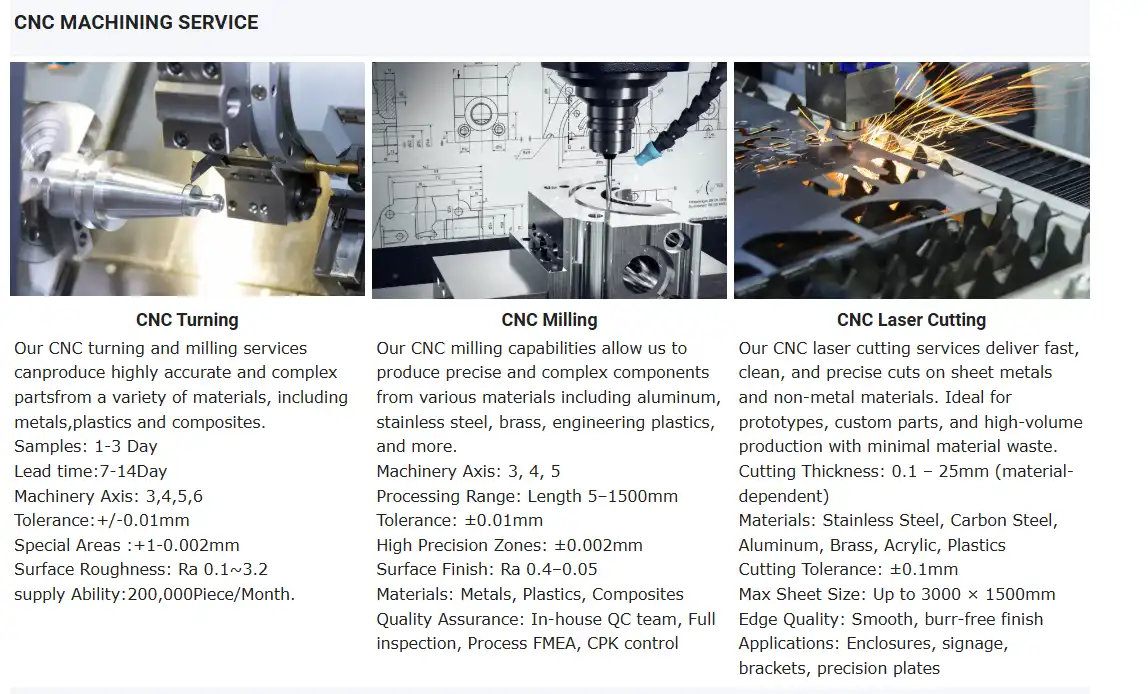
CNC turning, five-axis machining, EDM, stamping, hobbing, milling, grinding, and tapping boost procurement value when manufacturers build correct components. Precision manufacturing facilitates complicated camera system integration, reducing hardware compatibility concerns. Aluminium alloy is lightweight, stainless steel resists saltwater corrosion, brass conducts heat well, and speciality polymers cut manufacturing costs without sacrificing functionality.
Key Advantages of Factory-Direct Procurement for B2B Buyers
Direct manufacturer contacts boost procurement efficiency and dependability. Manufacturer-direct component purchases save money. Bulk purchase and reduced intermediary margins cut per-unit costs by 15-30%, depending on order size and complexity. Beyond cost, factory-direct connections provide procurement teams unmatched quality assurance, customisation iterations, and production scheduling.
Buyer-manufacturer interaction explains quality management. Certified ISO 9001:2015 and RoHS facilities provide systematic quality management across manufacturing cycles. Material certificates, batch inspection reports, and coordinate measuring machine dimensional accuracy checks benefit from openness. Factory linkages fix dimensions or surface finish concerns directly without distributor hierarchies, expediting problem resolution.
Perhaps the most customisable is factory-direct sourcing. Manufacturers may machine anodising, sandblasting, electroplating, brushing, black oxide coating, polishing, painting, blackening, electrophoresis, QPQ, and wire drawing for Custom Camera Parts. They affect aesthetics, corrosion resistance, conductivity, grip, and anti-reflective optical properties. Established manufacturing connections provide design iterations without vendor switching expenses when product or market needs change.
Critical Procurement Considerations for Camera Component Sourcing
Successful procurement strategies balance technology, supplier knowledge, and risk reduction. Custom parts must work with DSLR, mirrorless, movie, and industrial cameras. Even micron-level lens mount orientation errors may reduce picture quality or autofocus precision when mechanical connections align optical components.
Materials are thoroughly inspected beyond surface standards. Strength-to-weight ratios, thermal expansion coefficients, and machinability vary substantially across aluminium alloy grades. Environment impacts stainless steel corrosion resistance. Third-party testing of material certifications confirms mechanical and chemical composition for buyers.
Authenticating vendors decreases quality and supply chain issues. Facility audits, reference customer interviews, and sample validation testing are due diligence, along with business licenses and production certificates. Quality control, multi-year operating history, and open communication about manufacturing capacity and lead times are typical of established companies.
Where to Find Factory-Direct Custom Camera Parts Suppliers
Global Manufacturing Landscape and Regional Specialization
East Asia leads optical and electrical precision hardware production using CNC, injection, and metal finishing. In Dongguan, China's Pearl River Delta industrial region, Junsion Precision Hardware runs 32+ CNC machines in 1,600 square meters. Raw material sources, surface treatment experts, and quality testing laboratories are nearby, reducing lead times and logistical complexity.
Regional specialisation represents decades of industry and worker training. Manufacturers in these zones have developed tools to reduce heat distortion during tight-tolerance component machining. Surface treatment plants now satisfy worldwide corrosion resistance, environmental safety, and visual uniformity criteria, making them competitive.
European and North American production locations aid design team closeness, prototyping speed, and local content preferences. Higher per-unit expenses than Asian manufacture, quicker delivery, and better communication may justify a premium price for time-sensitive research or small-batch speciality applications.
Sourcing Channels and Supplier Verification Methods
Professional procurement teams use several avenues to find manufacturers for Custom Camera Parts. Specialised B2B websites list certified manufacturers with production and customer reviews. Trade organisations pick specialist and quality-certified manufacturers for global supplier directories. At trade events, buyers may check samples, negotiate bespoke conditions, and evaluate technical expertise.
Systematic supplier authenticity verification is essential. Documentation control, process validation, and continuous improvement are ISO 9001:2015 quality management practices. Electronics with RoHS certification fulfil environmental safety criteria. Customers and case studies confirm dependability, while third-party factory audits verify production and working conditions.
Communication infrastructure evaluation shows provider responsiveness and professionalism. Established manufacturers provide multilingual technical assistance, detailed product documentation, and clear pricing. Manufacturing companies that answer technical questions in 24–48 hours are attentive.
Comparing Factory-Direct Custom Camera Parts with Standard Market Options
Material Quality and Manufacturing Process Distinctions
Manufacturer-direct custom components employ premium materials for mechanical properties, not cost. Precision camera gear employs 6061-T6 or 7075-T6 aluminium alloys, which are stronger-to-weight than consumer-grade casting alloys. Unmarked steel in commodity hardware may rust in dampness or lubricants, whereas stainless steel components use 304 or 316 grades with corrosion resistance testing.
Bespoke manufacturing is more complicated than mass-market production. Five-axis CNC machining enables precise production of intricate patterns with tolerances of ±0.01mm. Cutting devices cannot offer accurate internal details like EDM. Precision grinding produces optical-grade mating surfaces with Ra0.8μm roughness, avoiding assembly micro-scratching.
Accelerated ageing and field performance show surface treatment quality differences. MIL-A-8625 verifies thickness and corrosion resistance of unique component anodising processes. Black oxide coating adhesion and salt spray testing. Sometimes generic components avoid certification, producing early finish degradation that compromises aesthetics and protection.
Pricing Structures and Total Cost of Ownership Analysis
Factory-direct procurement costs more per unit than distributor-sourced choices for small volumes. As order volumes and total cost of ownership grow, the economic equation alters substantially. Bulk production decreases unit costs by 20-35% from 500 to 1,000 units, depending on complexity and material needs. From prototype to commercial production, volume leverage helps product development.
Lead time requires strategic procurement schedule preparation. Distributor stocks ship quickly, but custom production takes 3-6 weeks. Generic components bypass design validation, material certification, first item inspection, and batch manufacturing documentation. Instead of reactive buying, sensible procurement teams forecast orders alongside manufacturing plans to address lead time constraints.
Warranty and after-sales service greatly impact ownership costs. Manufacturer-direct connections provide component design intent and application context that engineers have quick access to. Root cause analysis and manufacturer collaboration often enhance design after field failures. Distribution-sourced components have limited technical support and extended supplier chains, delaying responses and complicating warranty claims.
How to Choose the Right Factory-Direct Custom Camera Parts Supplier
Defining Your Procurement Scope and Technical Requirements
Effective supplier selection starts with clear requirement specification and quantitative assessment criteria. Manufacturers examine production capacity alignment and price tier eligibility using volume predictions for initial orders and expansion. Technical specifications must include dimensional tolerances, surface finish standards, material grade choices, and any industry-specific certifications needed for your application.
Clear delivery expectations avoid scheduling and inventory issues. Understanding manufacturer lead time, minimum order quantities, and production schedule flexibility helps design realistic project timelines. Preliminary negotiations should address payment terms, tooling costs for specific geometries, and design iteration modification processes before purchase commitments.
Evaluating Production Capacity and Quality Management Systems
Production capacity evaluation goes beyond machine counts to include workflow efficiency and scalability. Junsion's 32 CNC machines eliminate single-point bottlenecks during high-volume times. Teams working several shifts show flexibility and urgency. Equipment age and upkeep show technological currency and reliability standards that impact product consistency.
Certification of quality management shows comprehensive process control for Custom Camera Parts. Third-party certified ISO 9001:2015 certification proves compliance with worldwide quality standards for design control, buying, manufacturing, inspection, and corrective action. RoHS certifications prove restricted substance testing meets environmental standards. Manufacturers should give certification copies, audit reports, and quality manual summaries during assessment.
Customisation flexibility and technical assistance distinguish basic manufacturing shops from collaborative development partners. Manufacturers with in-house design teams may optimise component shapes for manufacturability, decreasing production costs while retaining functionality. Rapid prototyping speeds design validation and allows iterative refinement before production tooling expenditures.
Establishing Long-Term Partnership Foundations
Initial sampling and quality validation are crucial before large-scale commitments. Coordinate measuring machine dimensions verification, material certification review, surface finish evaluation, and camera assembly functional testing should be part of first item inspections. Discrepancy documentation and corrective action response during sampling indicate collaborative success.
Contract negotiation should include lead time stabilisation, price change triggers based on material cost volatility or volume thresholds, and exclusive design IP rights. Clear standards for bespoke tooling ownership, design data confidentiality, and quality dispute resolution eliminate expensive operational misunderstandings.
Product innovation collaboration turns transactional supplier connections into strategic collaborations. Manufacturers engaging in R&D might suggest material substitutions, design for manufacturability optimisations, or future technology uses that boost product competitiveness. Periodic business evaluations of quality measurements, delivery performance, and improvement programs sustain relationship momentum and value development.
Best Practices for Ordering and Maintaining Custom Camera Parts
Optimizing Your Factory-Direct Ordering Workflow
Effective procurement operations start with standardised inquiry forms that capture all technical needs in first discussions. Accurate pricing without repetitive clarification cycles is possible using 3D CAD models, dimensioned drawings with GD&T callouts, material specifications, surface finish requirements, and yearly volume estimates. Critical dimensions, aesthetic vs functional surfaces, and inspection criteria should be communicated to avoid expensive rework.
Production, quality inspection, and delivery must be coordinated for bulk orders. Consolidating component orders for container load optimisation cuts per-unit freight expenses. Understand customs paperwork, tariff classifications, and import duty consequences to avoid landed cost surprises. Through logistical agreements, reputable producers prepare business invoices, certificates of origin, and coordinate delivery.
Maintenance Protocols That Extend Component Lifespan
Precision camera hardware performance and TCO depend on proper maintenance of Custom Camera Parts. Routine cleaning processes should specify solvents that safely remove optical coatings without harming anodised surfaces or thread-locking compounds. Microfibre cloths protect finished surfaces, while compressed air cleans threaded interfaces and mechanical clearances.
Environmental control prevents corrosion and dimensional instability in storage. Climate-controlled facilities at 20-25°C and 40-60% relative humidity prevent moisture condensation on metal surfaces and dimensional changes in hygroscopic plastics. Anti-static bags, foam inserts, and desiccant packets preserve components during inventory.
Regular inspections spot wear before functional problems. Magnification shows galling or cross-threading damage in threaded interfaces. Anodised surfaces discolour or alter texture to show coating disintegration. Mechanical motions develop friction or binding before failure. Early detection allows planned replacement during maintenance windows, not emergency downtime.
Warranty Claims and Return Procedures
Understanding supplier warranty terms clarifies fault resolution expectations. Manufacturing flaws, material non-conformance, and dimensional variations above limits are usually covered. Photo documentation, dimension measurement data, and application context descriptions are frequently required. Initial acknowledgement, root cause investigation, and replacement component supply deadlines show supplier commitment to customer satisfaction.
Issues are resolved faster with clear communication. Troubleshooting is accelerated by dedicated technical support contacts that understand your program. Manufacturers with CRM systems that manage order histories, specification changes, and problem resolutions offer support continuity. Unresolved complaints are escalated to show organisational commitment to service quality beyond sales.
Conclusion
Strategic purchase of factory-direct bespoke camera parts offers cost savings, quality assurance, and customisation options. By working with manufacturers like Dongguan Junsion Precision Hardware Co., Ltd., procurement professionals can access advanced CNC machining, diverse material options, and ISO-certified quality management systems for ±0.01mm dimensional precision. Specialised surface treatments, stringent testing processes, and clear communication channels make supply chains more resilient than generic distributor partnerships. Understanding global manufacturing landscapes, implementing thorough supplier verification procedures, and forming collaborative partnerships focused on continuous improvement position your company competitively through superior component quality and reliable delivery performance that directly differentiates products in demanding imaging markets.
FAQ
1. How do I ensure compatibility of custom camera parts with my existing camera systems?
Compatibility verification requires detailed technical documentation exchange during design phases. Provide manufacturers with interface drawings specifying mounting dimensions, thread standards, and clearance requirements. Request dimensional inspection reports confirming critical features meet specifications. Conduct fit-check validation using actual camera bodies before approving production quantities. Reputable manufacturers offer sampling programs that enable physical testing within your assemblies, identifying interference issues or alignment concerns before tooling investments occur.
2. What are the main benefits of factory-direct purchasing versus distributor sourcing?
Factory-direct procurement eliminates intermediary margins, reducing costs by 15-30% on bulk orders while providing direct access to engineering teams for customization discussions. You gain transparency into quality control processes through facility audits and inspection report reviews impossible with distributor relationships. Lead times become predictable through production schedule visibility, and warranty claims resolve efficiently through direct manufacturer communication rather than multi-tier supplier chains.
3. Can manufacturers accommodate bespoke designs, and what are typical lead times?
Established precision hardware manufacturers routinely produce bespoke components tailored to proprietary specifications. Design feasibility depends on geometric complexity, tolerance requirements, and material selection. Typical lead times span 3-6 weeks encompassing design validation, material procurement, tooling preparation, first article inspection, batch production, quality verification, and shipping arrangements. Rush programs may compress timelines through expedited processing, though premium charges typically apply for accelerated scheduling.
Partner with Junsion for Your Custom Camera Parts Manufacturing Needs
Dongguan Junsion Precision Hardware Co., Ltd. stands ready to serve as your trusted custom camera parts supplier, delivering precision-engineered components that meet the imaging industry's most demanding specifications. Our 1,600-square-meter facility houses 32 advanced CNC machines operated by skilled technicians who maintain dimensional tolerances of ±0.01mm and surface roughness specifications reaching Ra0.8μm. We offer comprehensive material options including aluminum alloy, stainless steel, brass, and engineered plastics, complemented by diverse surface treatments from anodizing to black oxide coating. Our ISO 9001:2015 certification and RoHS compliance demonstrate systematic quality management aligned with international standards. Procurement managers seeking reliable partnerships with rapid response capabilities, flexible customization, and transparent communication will find exceptional value in our OEM/ODM manufacturing approach. Contact our technical team at Lock@junsion.com.cn to discuss your specific requirements, request sample components, or obtain detailed quotations for your upcoming projects.
References
1. Smith, J. and Wang, L. (2022). Precision Manufacturing Techniques for Optical Components. International Journal of Advanced Manufacturing Technology, Vol. 118, pp. 2341-2359.
2. Thompson, R. (2021). Supply Chain Optimization in Electronics Procurement: Factory-Direct Sourcing Strategies. Cambridge: Industrial Press.
3. Chen, M., Yamamoto, K., and Fischer, A. (2023). Quality Management Systems in Precision Hardware Manufacturing. Journal of Manufacturing Science and Engineering, Vol. 145(4), pp. 041002-041018.
4. Anderson, P. (2020). Material Selection for Camera System Components: Engineering Properties and Application Guidelines. New York: Technical Publishing House.
5. European Commission Joint Research Centre (2022). Best Available Techniques for Metal Surface Treatment and Finishing Operations. Publications Office of the European Union, Luxembourg.
6. International Organization for Standardization (2023). ISO 9001:2015 Quality Management Systems — Requirements and Implementation Guidelines for Manufacturing Industries. Geneva: ISO Standards Catalogue.