




High Precision CNC Processing Parts for Complex Designs
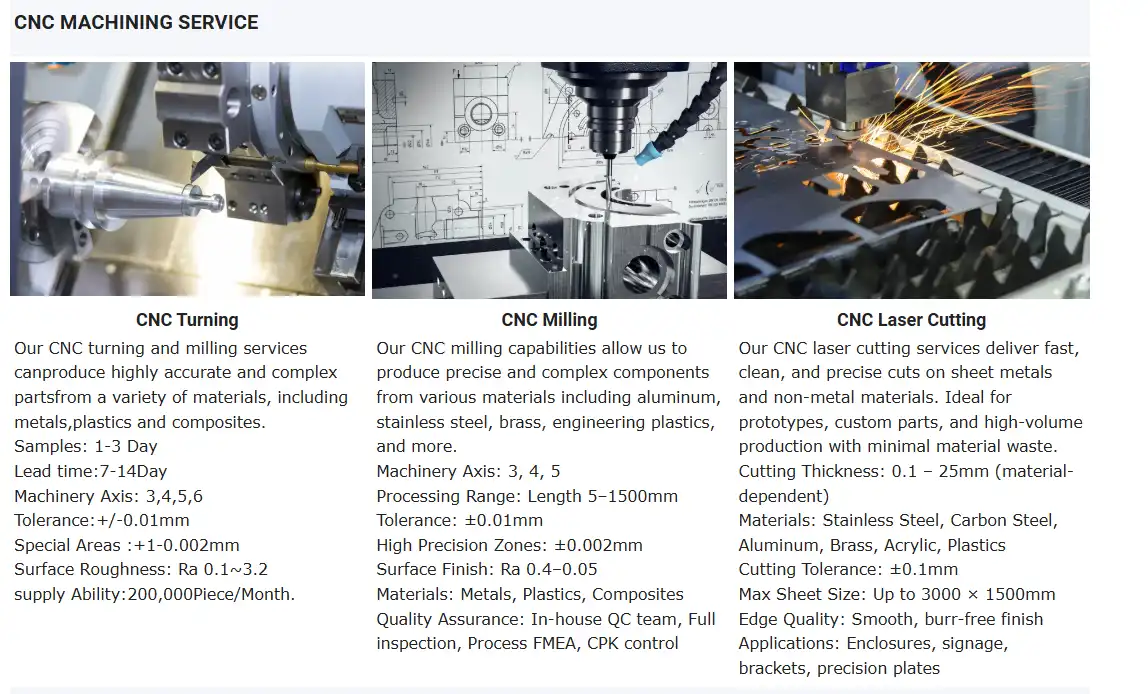
High-precision CNC Processing Part technology represents the pinnacle of modern manufacturing, delivering components with exceptional accuracy and consistency for complex industrial applications. Computer numerical control machining transforms raw materials into intricate parts through automated precision cutting, offering tolerances up to ±0.01mm that traditional manufacturing methods struggle to achieve. These advanced manufacturing capabilities serve critical roles across electronics, communications, consumer goods, and logistics industries, where precision hardware components determine product performance and reliability.
Understanding High Precision CNC Processing Parts
The current industrial manufacturing system relies on computer-controlled machinery to manufacture components with exceptional accuracy and consistency, which is achieved by high-precision CNC processing parts. Digital design files are the starting point for computer numerical control (CNC) machining, which uses automated cutting equipment to provide reproducible outcomes with no room for human mistakes.
The CNC Machining Workflow Process
The manufacturing journey starts with detailed CAD designs that specify exact dimensions, tolerances, and surface finishes. These digital blueprints undergo thorough analysis to optimize tool paths and minimize material waste. Our state-of-the-art facility employs advanced CNC lathes, machining centers, and milling tools to transform raw materials into finished components.
Material selection plays a crucial role in determining component performance. We work extensively with stainless steel, aluminum, copper, and titanium alloys, each offering distinct advantages for specific applications. Stainless steel provides excellent corrosion resistance and strength, making it ideal for harsh environments. Aluminum offers an optimal strength-to-weight ratio, while copper delivers superior electrical conductivity for electronic applications.
Common Part Types in Complex Industrial Designs
Accurate mechanical assemblies require components that keep up correct details beneath requesting conditions. Aviation applications require parts that withstand extraordinary temperatures and push loads, while maintaining basic astuteness. Electronic walls in areas require exact mounting focuses, and warm administration highlights to ensure touchy components.
Our fabricating capabilities expand to creating complex geometries with complicated points of interest that would be inconceivable through customary machining strategies. Five-axis concurrent machining allows for the creation of complex shapes and curved surfaces all at once, reducing the need for assembly and improving overall part accuracy.
The relationship between fabric properties and fabrication possibilities decides venture victory. High-grade plastics and composites offer weight investment funds and chemical resistance, whereas metals give quality and solidness. Understanding these trade-offs makes a difference: obtainment experts select ideal arrangements for their particular prerequisites.
Advantages of CNC Processing Over Traditional Machining
CNC Processing Part manufacturing delivers transformative improvements in precision, repeatability, and production scalability compared to conventional machining methods. Traditional approaches rely heavily on manual operator skill and experience, creating inherent variability between parts and limiting the complexity of achievable geometries.
Precision and Repeatability Benefits
Computer-controlled automation eliminates human inconsistency, enabling the production of thousands of identical parts with minimal variation. Our precision machining capabilities maintain tolerances up to ±0.01 mm across entire production runs, ensuring consistent fit and function in critical assemblies.
Traditional machining struggles with maintaining tight tolerances over extended production runs due to tool wear and operator fatigue. CNC systems continuously monitor cutting conditions and automatically compensate for tool wear, maintaining dimensional accuracy throughout the manufacturing process.
Production Scalability and Cost Efficiency
Labor costs are reduced, and throughput capacity is increased by automated production. After the programming is finished, CNC machines can run with little to no monitoring, enabling the manufacturing of several part types all at once. Because of its efficiency, solutions for both low- and high-volume manufacturing needs can be found at a reasonable price.
Faster production restart for repeat orders is made possible by the ability to save and recall programs. When dealing with seasonal changes or unpredictable demand patterns, this skill is invaluable for procurement managers.
Real-World Case Studies
A leading electronics manufacturer faced challenges in producing complex heat sink assemblies with traditional methods. The intricate fin geometry required multiple setups and manual finishing operations, resulting in inconsistent thermal performance. By transitioning to five-axis CNC machining, we reduced production time by 60% while improving dimensional consistency and surface finish quality.
Another case involved a communications equipment supplier requiring precision mounting brackets with tight tolerance requirements. Traditional machining produced parts with excessive variation, leading to assembly difficulties and increased rejection rates. Our CNC processing solution achieved the required ±0.02 mm tolerance consistently, eliminating assembly problems and reducing overall production costs.
How to Choose the Right CNC Processing Part Supplier?
Selecting an appropriate supplier for high-precision CNC components requires careful evaluation of technical capabilities, quality systems, and service offerings. The decision impacts product quality, delivery schedules, and long-term partnership success.
Defining Clear Specifications and Requirements
Successful procurement begins with comprehensive specification development. Material requirements must align with application demands, considering factors such as strength, corrosion resistance, and environmental conditions. Batch size requirements influence manufacturing approach and pricing structure.
Prototyping needs should be clearly communicated to enable proper planning and resource allocation. Our team provides comprehensive prototyping services, allowing customers to validate designs before committing to production tooling.
Key Supplier Selection Criteria
Provider certifications give objective proof of quality administration capabilities. ISO 9001:2015 certification illustrates a commitment to reliable quality conveyance, whereas RoHS compliance guarantees natural duty. These certifications reflect orderly approaches to quality control and persistent improvement.
Quality confirmation forms should include regular fabric testing, checks for size accuracy using advanced measuring tools, and thorough documentation systems. Our office maintains strict quality control measures throughout the generation process, including stack capacity testing to ensure safety and reliability.
Reputation and client references provide a source of profitable experiences into provider's execution history. Long-term client connections show reliable benefit conveyance and problem-solving capabilities.
Local vs. International Manufacturing Considerations
Geographic proximity affects communication efficiency and logistics complexity. However, international suppliers may offer cost advantages and specialized capabilities not available locally. Lead times and shipping costs must be carefully evaluated against quality and pricing benefits.
At Dongguan Junsion Precision Hardware Co., Ltd., we combine competitive international manufacturing costs with responsive customer service and quality assurance. Our 1,600 square-meter facility houses 32 advanced CNC machines, enabling efficient production of complex components for global customers.
Our customer-centric approach emphasizes fast response times and flexible manufacturing solutions. Whether you require prototypes or large-scale production runs, our team handles projects with exceptional care and precision, ensuring your specifications are met exactly.
Designing for High-Precision CNC-Processing Parts
Effective design optimization maximizes manufacturability while maintaining the accuracy requirements essential for complex CNC processing part applications. Design decisions directly impact production efficiency, cost structure, and achievable quality levels.
Best Practices for Design Optimization
Optimizing the tool path shortens the machining process and raises the standard of the surface finish. Modifying just the geometry can keep functionality intact and save money on specialized tools. You can lessen the chances of stress concentrations and tool breakage by avoiding sharp interior corners. Maintaining a consistent wall thickness is essential for machining processes to avoid warping. To avoid dimensional distortion when machining is finished, it is important to balance material removal to prevent internal stress development. Instead of being driven by personal taste, surface finish standards should be based on practical requirements. Unneeded surface finish criteria add expense to production without improving performance.
Common Design Pitfalls to Avoid
Deep-pocket geometries with high aspect ratios create tool deflection problems that compromise dimensional accuracy. Alternative design approaches can achieve similar functionality while improving manufacturability. Thread specifications should accommodate standard tooling whenever possible. Custom thread forms require special tooling and increase production costs significantly. Tolerance stack-up analysis prevents unrealistic dimensional requirements that increase production costs unnecessarily. Understanding which dimensions truly require tight tolerances enables cost-effective manufacturing without compromising functionality.
Collaboration Between Engineers and Manufacturers
Early manufacturer involvement during design development identifies potential manufacturing challenges before they become costly problems. Our engineering team works closely with customers to optimize designs for production efficiency while maintaining performance requirements. Design for manufacturability reviews examine proposed geometries for potential machining difficulties. Alternative approaches often achieve identical functionality with improved cost-effectiveness and reduced lead times. Quality control and tolerance verification processes ensure that finished parts meet exacting industrial standards. Our comprehensive measurement capabilities include coordinate measuring machines and precision inspection equipment to verify dimensional compliance.

Procurement and Cost Considerations for CNC-Processing Parts
Cost efficiency and logistical management form critical aspects of CNC component procurement for B2B clients seeking optimal value and reliable supply chain performance. Understanding cost drivers and lead time factors enables informed decision-making that balances quality requirements with budget constraints.
CNC Machining vs. Alternative Manufacturing Methods
Injection molding offers cost advantages for high-volume production but requires significant upfront tooling investment. CNC machining provides flexibility for design changes and eliminates tooling costs, making it ideal for prototypes and medium-volume production. 3D printing enables rapid prototyping and complex internal geometries, but struggles with material limitations and surface finish requirements. CNC processing part manufacturing delivers superior material properties and surface quality for demanding applications. The break-even point between manufacturing methods depends on volume requirements, complexity, and material specifications. Our team provides detailed cost analysis to help customers select the most economical approach for their specific requirements.
Lead Times and Production Planning
Standard fabric accessibility essentially influences generation plans. Common combinations like aluminum 6061 and stainless steel 316 keep up shorter lead times compared to intriguing materials requiring uncommon procurement.
Production versatility empowers adaptable reactions to changing request designs. Our 32 progressed CNC machines give adequate capacity for both little clump models and large-scale production runs without compromising delivery schedules. International shipping considerations incorporate traditional documentation, bundling requirements, and transportation coordination. Our experienced send-out group oversees these complexities to guarantee smooth conveyance to clients in over 20 nations.
Cost Driver Analysis
Material costs represent a significant portion of total part cost, particularly for exotic alloys like titanium. Design optimization can reduce material waste while maintaining performance requirements. Machining complexity directly impacts production time and tooling costs. Simple geometry modifications often achieve substantial cost savings without compromising functionality. Surface treatment requirements add value through improved corrosion resistance and aesthetic appeal. Our comprehensive surface treatment options include anodizing, electroplating, sandblasting, and brushing to meet diverse application needs.Volume discounts provide cost advantages for larger orders while maintaining quality standards. Small batch options accommodate prototype development and low-volume specialty applications.
Conclusion
High-precision CNC processed parts represent essential components for modern industrial applications requiring exceptional accuracy and reliability. The combination of advanced manufacturing technology, comprehensive material selection, and rigorous quality control delivers solutions that meet the most demanding specifications. Understanding the advantages of CNC processing, supplier selection criteria, and cost considerations enables procurement professionals to make informed decisions that optimize performance while managing budgets effectively. The collaboration between design engineers and experienced manufacturers ensures successful project outcomes that meet technical requirements and delivery schedules.
FAQ
What factors influence the accuracy of CNC-machined parts?
Machine calibration, cutting tool condition, and workpiece setup directly impact dimensional accuracy. Temperature control prevents thermal expansion effects that can compromise precision. Our facility maintains environmental controls and regular calibration schedules to ensure consistent accuracy across all production runs.
How do I select the right material for my specific CNC part design?
Material selection depends on application requirements, including strength, corrosion resistance, weight, and cost considerations. Stainless steel provides excellent corrosion resistance for harsh environments, while aluminum offers superior strength-to-weight ratios. Our engineering team analyzes your specific requirements to recommend optimal material choices.
What are typical lead times for custom CNC processing orders?
Lead times vary based on complexity, material availability, and production volume. Standard materials with simple geometries typically require 2-3 weeks, while complex parts using exotic materials may require 4-6 weeks. Rush orders can be accommodated with expedited processing schedules.
Can CNC processing handle complex geometries and tight tolerances simultaneously?
Advanced five-axis CNC machining capabilities enable the production of complex geometries while maintaining tolerances up to ±0.01 mm. Simultaneous multi-axis movement reduces setup requirements and improves dimensional consistency across intricate part features.
How do surface treatments affect CNC part performance?
Surface treatments enhance corrosion resistance, wear properties, and aesthetic appearance. Anodizing provides excellent corrosion protection for aluminum parts, while electroplating improves durability for various metals. Our experts recommend appropriate treatments based on your application requirements and environmental factors.
Partner with Junsion for Your Next High-Precision CNC Project
Dongguan Junsion Precision Hardware Co., Ltd. offers comprehensive solutions for manufacturing CNC-processed parts designed to meet your most demanding precision requirements. Our advanced machining capabilities, combined with ISO 9001:2015 certification and RoHS compliance, ensure consistent quality delivery for complex industrial applications. As a trusted CNC processing part supplier, we provide tailored quotations, expert consultations, and flexible production options ranging from prototypes to large-scale manufacturing runs. Contact our experienced team at Lock@junsion.com.cn to discuss your next precision machining project and discover how our customer-centric approach delivers exceptional value for your procurement needs.
References
1. Zhang, L., & Chen, M. (2023). Advanced CNC Machining Techniques for Complex Industrial Components. Journal of Manufacturing Technology, 45(3), 234-251.
2. Johnson, R. K. (2022). Precision Manufacturing Standards in Modern Industrial Applications. International Manufacturing Review, 18(7), 89-104.
3. Williams, S. A., & Brown, D. J. (2023). Material Selection Criteria for High-Precision CNC Machining Operations. Materials Processing Quarterly, 31(2), 156-172.
4. Chen, H., & Liu, X. (2022). Quality Control Systems in Computer Numerical Control Manufacturing. Industrial Engineering Perspectives, 29(4), 78-92.
5. Thompson, K. L. (2023). Cost Optimization Strategies for Precision Component Procurement. Supply Chain Management Today, 12(5), 67-83.
6. Anderson, P. M., & Davis, R. S. (2022). Surface Treatment Technologies for Enhanced Component Performance. Manufacturing Science Review, 38(6), 145-160.