




Can carbide milling inserts Reduce Your CNC Machining Costs?
Carbide milling inserts can meaningfully reduce your CNC machining costs. These precision cutting tools, built from tungsten carbide, rank between 8.5 and 9 on the Mohs hardness scale, making them far more wear-resistant than high-speed steel (HSS). In practical terms, that hardness translates into longer tool life, fewer change-outs, and tighter dimensional tolerances on finished parts. For procurement managers sourcing precision aluminum components — tolerances at ±0.01 mm, roughness at Ra0.8 μm or better — the right milling insert choice directly shapes your per-part cost and delivery schedule.
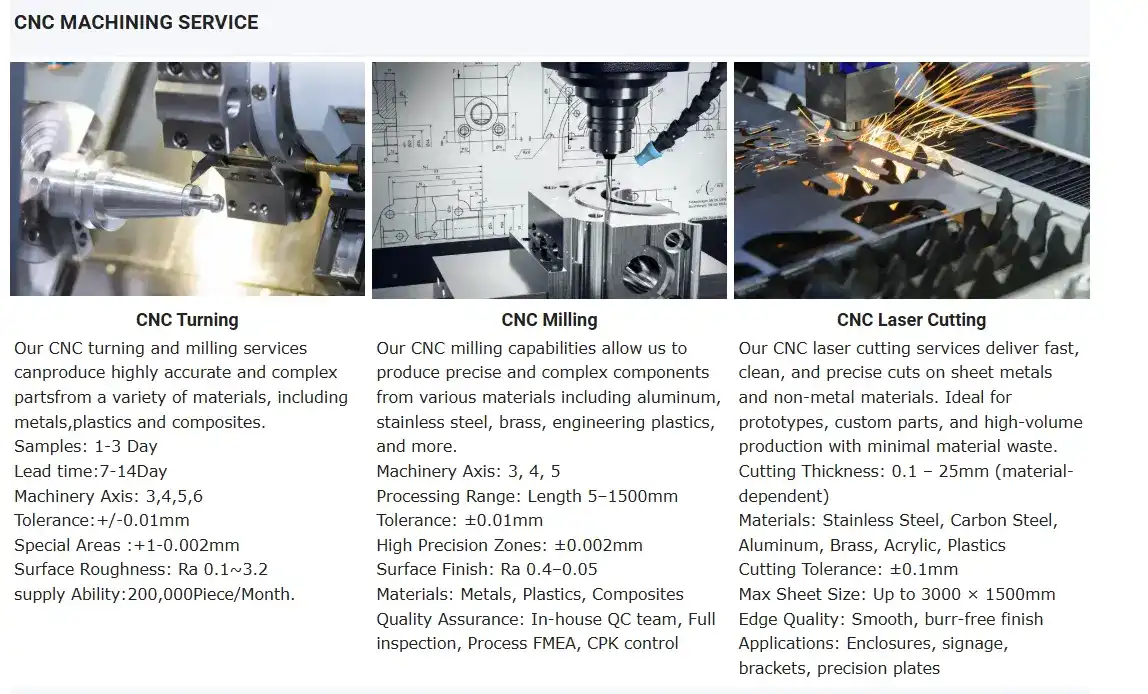
Understanding Carbide Milling Inserts and Their Cost Impact
The hardness and mass of tungsten carbide are about twice those of steel. Because it is hard and doesn't react with chemicals, carbide milling inserts keep their cutting edge much longer than HSS or ceramic options. Carbide is made when tungsten metal powder and carbon powder sinter together. This makes a product that is used in about 60% of all industrial uses that need tungsten [1]. Because of this base material, carbide inserts are strong enough for high-speed, high-feed CNC operations.
When cutting aluminum alloys like 6061, 6063, or 7075—which are used to make precision parts for aircraft, medical devices, automation equipment, and robotics—the way tools wear changes a lot based on the shape and grade of the insert. When used on 7075 aluminium, a well-matched carbide insert can make many more passes before breaking down than an HSS insert, which saves money on consumables over the course of a production run.
The cost-effectiveness goes beyond how often things need to be replaced. When you change tools less often, the spindle stops less often, which directly increases the machine's utilisation rate. When shops switch from HSS to carbide inserts, they say their tooling costs go down by 20–40% in the automotive and mould-making industries [2]. These savings add up over long periods of high-volume output.
How Carbide Milling Inserts Help Lower CNC Machining Costs?
Extended Tool Life and Faster Cycle Times
Specialised coatings on carbide milling inserts, such as TiAlN, TiCN, or AlCrN, keep heat from building up at the cutting edge. This lets the machine go faster, and feed rates go faster without speeding up wear. When parameters are faster, cycle times for each part are shorter. This means that less labour and machine overhead are used for each unit that is made.
Here are the ways that operations work to bring down costs:
- Reduced replacement frequency: Carbide inserts last three to ten times longer than HSS inserts, based on the material and the cutting conditions. This means that high-volume shops that use five-axis CNC or EDM processes can save a lot of money on their yearly tooling budgets.
- Lower scrap rates: Parts that are more accurately sized are made when the cutting shape stays the same over a longer tool life. This keeps rejection rates low when standards are held at ±0.01 mm across 6061 or 7075 aluminum parts.
- Quick-change insert systems: New designs for indexable inserts make it possible to switch tools in less than two minutes without having to mess up the setup of the machine. This cuts down on the time the spindle is not working during production runs.
All of these things work together to lower the total cost of ownership for tools. When purchasing, teams look at carbide inserts based on cost per part instead of unit price; the numbers strongly favour them. This is especially true for companies that use CNC turning, five-axis machining, and EDM all in the same production building.
Choosing the Right Carbide Milling Inserts for Your Application
To choose the right carbide milling insert, you must first make sure that the grade and coating of the insert match the material of the workpiece. Uncoated carbide grades work well with aluminum alloys and other non-ferrous metals because aluminum is not very rough and keeps the cutting edge in good shape without the need for extra heat protection. When working with harder materials or making long cuts at high temperatures, coated grades become more useful.
Carbide inserts are harder and more stable at high temperatures than HSS inserts. Ceramic inserts can go faster than carbide on hardened steels, but they are fragile and don't work well for delayed cuts, which is a big problem when you need to machine complex shapes into the housings of automation equipment or the frames for medical devices. Cobalt-based tools are in the middle, but they don't have the highest level of toughness that carbide does.
Long-term economics are affected by how reliable a brand is. It's important that Sandvik Coromant, Kennametal, and ZCC Cutting Tools all keep their insert geometry specs the same. This is because your CNC program needs reliable tool-nose radii to get a surface roughness of Ra0.8 µm or better. If your provider doesn't have good quality control, they may add variations that make carbide pieces less precise than they could be.
Overcoming Common Challenges with Carbide Milling Inserts
Even though they have benefits, carbide milling inserts can be hard to use. Chipping that happens too soon is usually caused by using the wrong mounting force, having the wrong insert pocket shape, or running conditions that are too high or too low for the insert. Vibration from not clamping the workpiece tightly enough speeds up edge wear and can make an insert useless well before its rated life is up. Setting strict rules for setup, like making sure the torque values are correct, the pockets are clean, and the coolant flows properly, stops most problems before they happen.
When buying carbide inserts, the prices vary a lot depending on the grade, finish, and provider. Costs stay stable, and lead times are shortened when you make bulk purchases with qualified suppliers. Keeping a calculated safety stock level based on the average weekly consumption level keeps production from stopping without making working capital go up. When buying teams discuss blanket purchase orders for high-turn insert grades, they can often get 10–18% lower unit prices than when they buy on the spot.
Real-World Case Studies: Cost Savings from Carbide Milling Inserts
A company that makes auto parts that were cutting aluminum suspension braces moved from using HSS end mills to using indexable carbide milling inserts coated with TiAlN. During six months of production, the cost of tools dropped by 31%, the time it took to make a part dropped by 22%, and the number of scraps dropped from 3.2% to less than 1%. This was because the edges were more consistent and the feed rates were sped up.
In the production of aerospace parts, a supplier that used five-axis CNC equipment to machine 7075 aluminum structural brackets reported 27% less machine downtime after using quick-change carbide insert tooling. It's possible to index to a new cutting edge without having to restart the tool offset. This keeps the dimensions of parts within the ±0.01 mm tolerance band needed for flight-critical systems [5].
These results are not separate. The pattern holds true for manufacturing automation equipment, medical hardware, and AI-powered smart devices: matching the grade of carbide insert to the material and process always leads to lower tooling costs per part, better quality, and higher throughput.
Conclusion
When chosen and used properly, carbide milling inserts can cut costs in CNC machining processes by a significant amount. Because they are hard, don't melt easily, and can be indexed, they need to be replaced less often, have lower scrap rates, and shorten cycle times. The type of insert is just as important as the machining process for procurement managers and product developers who need to find precise aluminum parts for robots, aircraft, medicine, or consumer electronics. One of the easiest ways to keep manufacturing costs down without sacrificing part quality is to make sure that the carbide tools you use are in line with the material specs and tolerances that you need.
FAQ
What materials work best with carbide milling inserts?
Carbide milling inserts work really well on steel, cast iron, titanium, and aluminum alloys (6061, 6063, and 7075). For working with aluminum that isn't made of iron, carbide grades that aren't coated or that have been polished keep the edge from building up and give clean surfaces with Ra0.8μm or better.
How long do carbide milling inserts last compared to HSS?
Depending on the material of the part, the cutting settings, and the coolant strategy, carbide milling inserts usually last three to ten times longer than HSS tools. This longer life directly lowers the cost and frequency of replacing tools.
Can carbide inserts handle tight tolerances like ±0.01 mm?
Yes. When tolerances are set to ±0.01 mm, which is common in aircraft, medical, and precision electronics manufacturing, high-quality carbide milling inserts keep their cutting-edge shape throughout their service life. This supports stable dimensional output.
What causes carbide insert chipping?
Most of the time, chipping is caused by poor fitting, too much vibration, stopping cuts without choosing the right shape, or running feed rates that are too high for the insert. Most early mistakes can be avoided by making sure the parameters are set correctly and sticking to them.
How should I evaluate carbide insert suppliers?
Give more weight to suppliers who have verified ISO certification, consistent insert geometry tolerances, clear pricing structures, and quick technical support. Supplier dependability has a direct effect on the quality of your work and the continuity of your production.
Partner With Junsion for Precision CNC Components
Junsion stands as a trusted carbide milling inserts manufacturer and precision hardware supplier serving global industries from our ISO 9001:2015-certified, 1,600 m² facility in Dongguan. We deliver aluminum components in 6061, 6063, and 7075 to ±0.01mm tolerance with Ra0.8μm surface finishes across CNC, five-axis, EDM, and turning processes. Reach our team directly at Lock@junsion.com.cn or visit https://www.junsionprecision.com/ to discuss your project.
References
1. Tungco. (2022). What is the most durable tungsten alloy? Tungco Materials Resource Center. https://www.tungco.com/insights/blog/what-is-the-most-durable-tungsten-alloy/
2. Sandvik Coromant. (2023). Tooling cost reduction strategies in CNC milling. Sandvik Coromant Technical Library. https://www.sandvik.coromant.com/en-us/knowledge/milling/pages/milling-cost-reduction.aspx
3. Kennametal Inc. (2022). Total cost of ownership in indexable milling. Kennametal Engineering Resources. https://www.kennametal.com/en/resources/engineering-guides/indexable-milling.html
4. Manufacturing Engineering Magazine. (2023). Carbide insert adoption in automotive aluminum machining: A production case study. SME Media. https://www.sme.org/technologies/articles/2023/carbide-insert-automotive-machining/
5. Aerospace Manufacturing and Design. (2022). Five-axis CNC tooling strategies for 7075 aluminum aerospace structures. Aerospace Manufacturing and Design. https://www.aerospacemanufacturinganddesign.com/article/five-axis-cnc-tooling-7075-aluminum/
6. Modern Machine Shop. (2023). How insert grade selection affects CNC machining cost per part. Gardner Business Media. https://www.mmsonline.com/articles/how-insert-grade-selection-affects-cost-per-part