




Custom Metal Hardware Materials and Manufacturing Process Guide
To find the right precision parts, you need to know about both the products and the methods. Instead of using off-the-shelf bolts, brackets, machined parts, and structural components, custom metal hardware is made to exact specs. These customized solutions meet the style, size, and performance needs of a wide range of businesses, such as those that make medical devices, robots, aerospace equipment, and medical devices. When purchasing managers look at different metal hardware choices, they check the properties of the metal, the accuracy of the manufacturing process, the surface treatments, and the dependability of the suppliers to make sure the parts fit perfectly into their systems. We at Dongguan Junsion Precision Hardware Co., Ltd. use advanced cutting techniques and strict quality standards to make sure that the metal parts we sell are precisely designed to meet your needs.
Understanding Custom Metal Hardware Materials
Choosing the right materials is the first step in successfully buying components. The choice has a direct effect on how long something lasts, how well it works in different environments, and how much it costs to own overall. The people who work in procurement have to balance many different factors, such as mechanical strength, resistance to corrosion, weight, temperature stability, and budget limits.
Stainless Steel Grades and Applications
Because it doesn't rust and has excellent mechanical qualities, stainless steel is still the most popular choice for fine hardware. We do a lot of work with several grades that are specifically made for different uses:
316 stainless steel is excellent at resisting rust, especially in chloride-based settings and marine ones. Because it has molybdenum in it, this austenitic grade is perfect for medical tools, pharmacy equipment, and marine uses where contamination or rust could hurt performance.
304 stainless steel is easier to shape and join than 316 stainless steel, but it costs less. This grade can be used for many different things, like general-purpose food processing equipment, housings for consumer electronics, and building hardware where mild corrosion resistance is enough.
303 stainless steel features enhanced machinability due to added sulfur, making it optimal for high-volume precision-turned components like fasteners, fittings, and shafts. It doesn't prevent rust as well as 304, but it has better surface finishes and better tolerances for CNC processes.
410 stainless steel is a martensitic metal, which means that it gets stronger and harder when heated. This magnetic grade is well-suited for things like valve parts, pump shafts, and cutting tools that need to be resistant to wear.
At our facility, the first step in choosing materials is to learn about your operating surroundings. Parts that are exposed to chemicals, water, or high or low temperatures need different metal formulas than parts that are used in a controlled environment inside.
Aluminum Alloys for Lightweight Solutions
Aluminum is strong for its light weight, making it useful in aircraft, cars, and small electronics. Its natural oxide layer protects against rust pretty well, and anodizing processes make the surface last a lot longer. Aluminum machines quickly, which cuts down on the time and money needed to make complicated shapes. But because it isn't as strong in tensile strength as steel, it needs to be carefully designed for load-bearing uses. We often suggest aluminum for housings, brackets, heat sinks, and structural frames where a lighter material gives clear performance benefits.
Specialty Materials: Titanium, Brass, and Copper
Titanium gear has the best strength-to-weight ratio and is very resistant to rust. Titanium is pricier, but it is worth it in aircraft, high-performance cars, and medical implant uses where its biocompatibility and durability make it worth the money. Titanium fasteners keep the structure strong in harsh conditions while lowering the total weight of the unit.
Brass and copper are used in specific ways when electrical transfer, heat control, or how something looks are important. Because they are naturally antimicrobial and easy to machine, brass fasteners can be used for both nautical gear and artistic purposes. Copper parts work great in heat exchanges, electrical connections, and other places that need non-sparking qualities.
Choosing the right material affects every choice that comes after, from the factors of the machining to the surface treatments. Our engineering team helps clients weigh the pros and cons of performance needs and price limits, making sure that the best materials are chosen from the start of a project.
Custom Metal Hardware Manufacturing Process Overview
When procurement managers understand how factories work, they can set realistic deadlines, find quality checkpoints, and clearly explain specifications. Digital design tools, advanced machining centers, and strict checking procedures are all used in the manufacturing of custom metal hardware today.
Design Development and Engineering Review
A careful design study is the first step in any project that turns out well. We need thorough 2D or 3D CADs that show the sizes, tolerances, material requirements, and surface finish needs. Our engineering team reviews applications to see if we can make them. They look for problems like undercuts that make cutting harder, wall thicknesses that make the product less strong, or tolerance stackups that make the product pricier.
This joint study often shows where we can improve. Making small changes to the design, like changing the distance between holes or making the shapes simpler, can greatly cut down on production time and costs without affecting the usefulness. We provide feedback on designs within 24 hours, which helps with fast development processes that are important in competitive markets.
Precision Machining Technologies
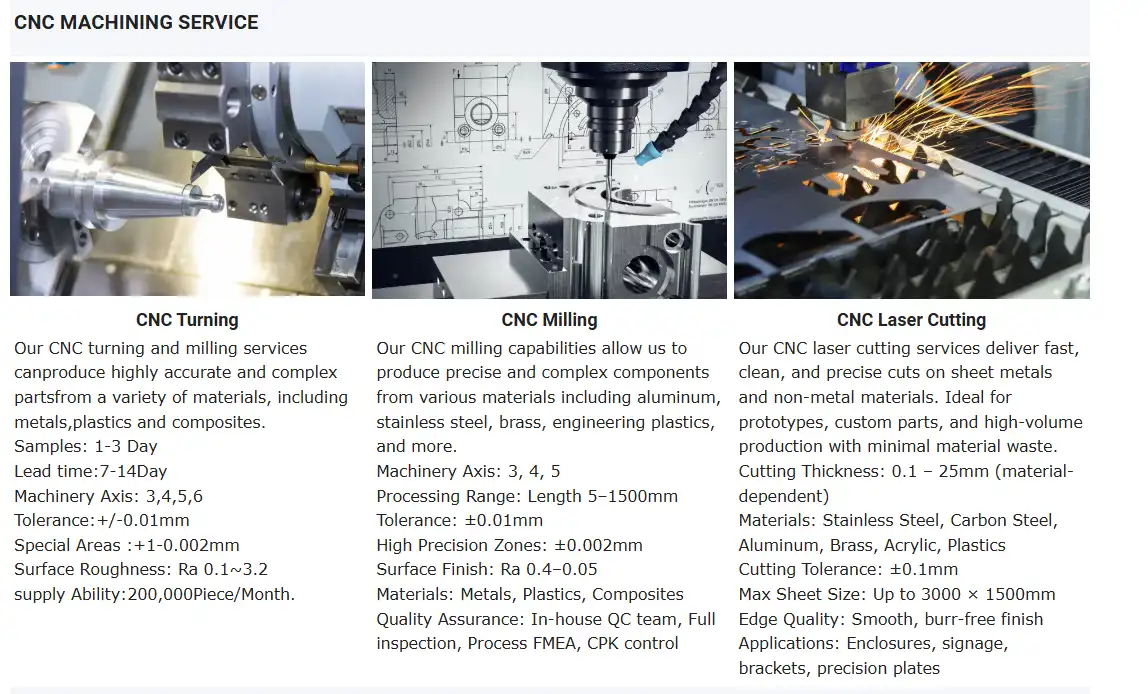
Our building is 1,600 square meters and has 32 high-tech CNC tools that can hold tolerances of up to ±0.01 mm and have a surface roughness of less than or equal to 0.8 μm. This level of precision is ideal for hard uses in medical devices, aircraft parts, and electronics, where accurate measurements have a direct effect on the quality of the assembly and the performance of the product.
CNC turning produces cylinder-shaped parts such as shafts, pins, and bushings, which are perfectly centered and have a smooth surface. Multi-axis lathes can handle complicated shapes in a single setup, which cuts down on the time needed for handling and keeps standards tighter.
Five-axis machining enables the creation of shapes with undercuts, compound angles, and sculpted surfaces. This technology cuts down on setup time, improves surface quality, and keeps features in the right place even when they're very complicated. It's important for making aerospace braces, robotic joint parts, and custom medical tools.
Stamping operations deliver high-volume production efficiency for flat parts like clamps, clips, and fixing plates. Progressive dies can make thousands of parts per hour with uniform quality, making stamping ideal for consumer electronics hardware and automotive fasteners.
The machining method depends on the part shape, production volume, material properties, and required tolerances. Our production planning team chooses the best methods based on quality, wait time, and cost.
Surface Treatment and Finishing
Surface treatments make parts look better, make them last longer, and give them useful qualities like better protection against electricity or less friction. We offer a wide range of finishing options:
- Anodizing adds a strong oxide layer to metal parts, which makes them more resistant to rust and lets you change the color.
- Electroplating adds metals like nickel, chrome, or zinc to make things look better and protect them from rust.
- Sandblasting makes smooth finishes that are regular, gets rid of surface imperfections, and makes it easier for coatings to stick.
- Powder coating uses long-lasting polymer finishes that won't chip, scratch, or break down in UV light.
- Polishing makes the sides of medical tools and parts that people see look like mirrors.
- Electropolishing makes the coating thickness uniform, even on shapes with many holes and complex contours.
Treatment selection depends on the operational surroundings and practical needs. For cleaning and safety, medical parts often need to be electropolished. Powder coating, on the other hand, protects outdoor gear from the weather.
Quality Control and Certification
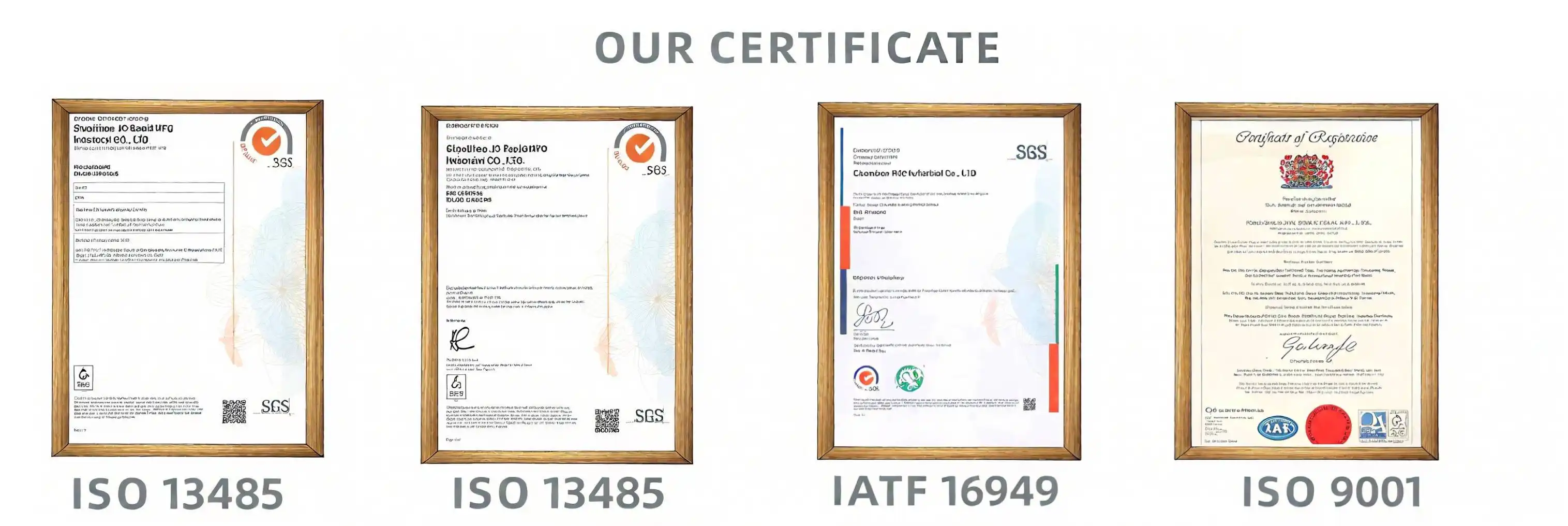
Quality control starts with inspecting new materials and goes on through all stages of production. Our ISO 9001:2015-certified quality management system keeps records of processes, makes sure they can be tracked, and makes sure that production runs are all the same.
We employ advanced inspection equipment, including coordinate measuring machines, 2.5D optical projectors, hardness tests, and salt spray tanks for checking. During production, random sampling checks the accuracy of the dimensions, the quality of the surface finish, and the material's features. All critical measurements are checked one hundred percent before they are packed.
All materials comply with the RoHS rules, which limit the use of dangerous materials like lead and mercury. European exports come with proof that they follow REACH rules, and aerospace clients get proof that they meet AS9100 standards. This detailed paperwork helps you meet your legal compliance and supply chain openness requirements.
Advantages of Custom Metal Hardware Over Standard Hardware
While off-the-shelf parts can be used in a wide range of situations, personalized solutions offer measurable benefits that make the design work and tooling investment worthwhile.
Perfect Fit for Unique Design Requirements
Standard hardware makes designers make trade-offs, like changing the shapes of holes, working with dimensions that aren't ideal, or adding adapter plates that make the design heavier and more complicated. Custom parts fit right into your systems, so you don't have to pay extra for adaptations or worry about failure points. This exact integration is very useful for small electronics, medical tools that have to stay within very strict size limits, and aircraft parts where every gram counts.
We often make clamps that fit certain mounting patterns, fasteners with special head shapes for tool clearance, and structural parts that are best for distributing certain loads. These custom solutions get rid of the design limitations that come with using stock parts.
Enhanced Performance and Reliability
Customization lets you choose the best material and treatment for your unique working conditions. Standard steel screws might use an 18-8 alloy that is suitable for most uses. For more chemical protection, 316 grade is available, and 410 grade is available for applications that need more strength.
Surface solutions can be perfectly matched to the surroundings. Parts that will be exposed to salt spray get special finishing, and parts that will be in high-temperature areas get the right heat treatment. This focused optimization increases service life and lowers the need for upkeep, which lowers the total cost of ownership even though the original piece prices were higher.
Supply Chain Efficiency and Scalability
Setting up ties with companies that make custom metal hardware gear has benefits for the supply chain that go beyond the parts themselves. Quick reorders are possible with dedicated tools, established methods, and written requirements. This avoids long requoting cycles. Production scalability lets you go from making a few prototypes to making a lot of them without having to rethink the whole thing.
Many clients start by getting unique hardware for their flagship goods. As trust and communication improve, they then grow the relationship to include related parts. This combination cuts down on the costs of managing suppliers, makes it easier to coordinate deliveries, and often leads to better prices based on volume.
Customization helps products stand out as well. Copying is harder when fasteners have unique designs, branded finishes, or built-in features that make the product seem higher quality. In competitive markets, these small differences help brands stand out.
How to Choose the Right Custom Metal Hardware Supplier?
Choosing the right supplier has a big effect on the quality of the product, the time it takes to create, and the long-term prices of production. Professionals in procurement should look at more than just unit price when making decisions.
Certification and Compliance Verification
Quality badges show that a process is mature and that a company is committed to meeting standards. Getting ISO 9001:2015 certification shows that you have a documented quality management system with methods for ongoing growth. Certifications that are specific to an industry, like AS9100 for aircraft or ISO 13485 for medical equipment, show that you know how to follow strict rules.
You should ask for proof of claims and audit reports instead of taking them at face value. Check the testing procedures for RoHS compliance and look over the paperwork that shows how materials can be tracked. For important uses, suppliers should give mill papers that show what the material is made of and its mechanical qualities.
Technical Capability Assessment
Compare the manufacturing skills to your unique needs. Some shops aren't able to regularly meet standards of ±0.01mm or make surfaces that are Ra0.8μm. Ask for studies that show how statistical process control works for important variables. Check the equipment lists to make sure you have the right tools, like five-axis machining centers for complicated shapes, automatic inspection equipment for large-scale production, and environmental testing rooms to make sure the equipment is reliable.
Technical response is just as important. Suppliers should help with engineering during the planning process by offering ways to make the product easier to make and different materials. Quick-turn development lets you make changes to your idea several times before committing to making the actual tools. We usually send concept models within 5 to 7 business days, which helps with tight deadlines for development.
Lead Time Transparency and Flexibility
Accurate lead time predictions keep output from stopping. Suppliers should make it clear what the usual lead time is from placing an order to delivery, separating trial runs from mass production. Being open about schedules and capacity limits helps with planning output better.
Being flexible is useful when things change in the market. Suppliers who can rush pressing orders or change production plans can help businesses deal with changes in demand. Our production planning system keeps extra capacity for projects that need to be done quickly, while also keeping planned supplies for obligations that have already been made.
Total Cost Analysis
The unit price is only one part of the cost. Think about things like the cost of tools over time, the minimum order quantity, payment terms, shipping costs, and quality-related costs such as review time or failure rates. When suppliers offer design optimization, they may be able to cut down on the amount of material used or make the manufacturing process simpler, which can lower total costs even if piece prices stay the same.
Costs and risks are both affected by where you live. Domestic suppliers have shorter wait times, make it easier to communicate, and charge less for shipping. On the other hand, foreign makers may offer lower prices for large quantities of common goods. From our Dongguan center, we serve customers all over the world, balancing low prices, quick response times, and consistent quality.
Environmental Impact and Sustainability of Custom Metal Hardware
Sustainability is becoming more important in purchasing choices as companies deal with their environmental duties and government rules. Making tools out of metal has natural benefits for longevity and offers chances to keep getting better.
Material Lifecycle and Recyclability
Metals are naturally sustainable materials because they can be recycled over and over again without losing any of their performance. Steel and aluminum keep their traits even after being melted down and reformed many times, which opens up real possibilities for the circular economy. A lot of reclaimed material is used to make stainless steel—usually 60% or more—but it still has the power and resistance to corrosion of new material.
The products we buy come from suppliers who keep track of the percentages of recycled content and give us information on how they affect the earth. This traceability helps you meet the standards for reporting scope 3 pollution and talking about sustainability. By choosing products that have a lot of recycled content, you can reduce your impact on the world without lowering the quality of the parts.
Manufacturing Process Efficiency
Modern CNC cutting makes better use of materials by using efficient toolpaths and making less scrap. Our five-axis tools cut down on waste by making it possible to make complicated shapes from smaller pieces of stock. Precision production also lowers the number of defects, so there is no longer any environmental cost to making and throwing away parts that don't meet standards.
We use energy-efficient methods, such as LED lights, smart ordering of machines to cut down on idle time, and coolant recycling systems. By cutting down on fluid management, contamination can be avoided, fluids can last longer, and less waste is thrown away, which has a positive effect on the earth.
End-of-Life Considerations
Design for dismantling principles make it easier to separate parts when a product is no longer needed, which makes material recycling easier. End-of-life recycling is helped by using standard bolt types and avoiding combining metals that are not the same, which makes recycling harder. We help our clients make design decisions that balance how quickly something can be made with how easily it can be recycled.
Some surface processes make things less recyclable. Some covering systems need to be removed before they can be recycled, but mechanical finishes like cleaning or brushing keep the full recycling potential. We help our clients weigh their treatment choices while taking environmental concerns and performance needs into account.
Conclusion
Procurement experts can choose parts that are the best in terms of performance, cost, and dependability by knowing how to make them and choosing the right materials. Properties of materials, like how resistant stainless steel is to corrosion and how strong titanium is compared to its weight, must match operating conditions and useful needs. Precision in manufacturing, especially getting limits of up to ±0.01mm and surface finishes of 0.8μm or less, has a direct effect on the quality of the assembly and how well the product works. Custom metal hardware gives you a competitive edge by letting you integrate designs perfectly, making them more reliable, and streamlining the supply chain in ways that standard parts can't. Instead of just looking at unit price, suppliers should be judged on their certifications, professional skills, ability to communicate clearly, and pledges to sustainability. At Junsion, we use cutting-edge production technology, strict quality control systems, and teamwork to make sure that the metal parts we send you are exactly what you need and help you meet your sustainability goals and stay ahead of the competition.
FAQ
What factors most influence custom metal hardware pricing?
The main things that determine prices are the type of material used, the complexity of the shape, the needed tolerances, surface treatments, and the amount that is made. Exotic materials like titanium cost more than standard stainless steel. Tighter standards need more time and checking during machining. When shapes are complicated, five-axis machining may be needed instead of easier turning processes. Surface finishes make the process take longer and cost more in materials. When you buy more, you can spread out the costs of setup and tools over a longer period of time, which lowers the price per piece of custom metal hardware by a large amount.
What typical lead times should we expect for custom metal hardware projects?
Depending on how complicated they are, prototypes take between 5 and 10 workdays to make, and production runs take between 2 and 6 weeks, depending on the number of items and the requirements. Initial orders take time to prepare the tools, but reorders ship faster using tried-and-true methods. Rush services can meet your pressing needs, but they may have an effect on the cost. Making sure that everyone involved in the quote understands the timeline requirements allows for more realistic scheduling and avoids delivery shocks for custom metal hardware projects.
How do we ensure compliance with industry-specific standards?
Ask for certifications that are right for your business, like AS9100 for aerospace, ISO 13485 for medical products, or IATF 16949 for cars. Check the material's approvals, such as mill certificates and paperwork showing that it meets RoHS requirements. Make sure that buy orders have clear specs that refer to relevant standards. Suppliers with a good reputation keep records that make it possible to track everything from raw materials to finished parts. This makes it possible to do a check if necessary.
Partner with a Trusted Custom Metal Hardware Manufacturer
JunSion makes precision-engineered metal parts for the medical, aircraft, automobile, robotics, and automation businesses around the world. Our 32 high-tech CNC machines can hold tolerances of up to ±0.01mm and have a surface roughness of less than or equal to 0.8μm. This means that the quality of our products is the same from trials to large-scale production. As well as 316/304/303/410 stainless steel, aluminum, titanium, brass, and copper, we work with a wide range of materials and treat their surfaces in a variety of ways, such as by anodizing, electroplating, powder coating, and polishing. Our ISO 9001:2015-certified quality system and RoHS-compliant products make sure that the quality of your parts meets international standards. Our engineering team can help you with design optimization and quick development, whether you need precise CNC parts, turned components, custom fasteners, or stamped metal hardware. Get in touch with our technical team at Lock@junsion.com.cn to talk about your needs and get a full quote from a custom metal hardware provider that is dedicated to quality, creativity, and quick service.
References
1. Davis, J.R. (2018). Metals Handbook: Properties and Selection of Stainless Steels, Tool Materials, and Special-Purpose Metals. ASM International Publishing.
2. Kalpakjian, S. & Schmid, S.R. (2020). Manufacturing Engineering and Technology (8th Edition). Pearson Education.
3. Groover, M.P. (2019). Fundamentals of Modern Manufacturing: Materials, Processes, and Systems (7th Edition). Wiley Publishing.
4. American Society for Quality (2021). Quality Management Systems for Manufacturing: ISO 9001 Implementation Guide. ASQ Quality Press.
5. Boyer, R., Welsch, G., & Collings, E.W. (2017). Materials Properties Handbook: Titanium Alloys and Specialty Metals. ASM International.
6. Society of Manufacturing Engineers (2022). Precision Machining Technology: CNC Processes and Quality Control Standards. SME Technical Publications.